What Do Goats Eat? A Complete Goat Feeding Guide (Plus Toxic Plants to Avoid)
Quick answer
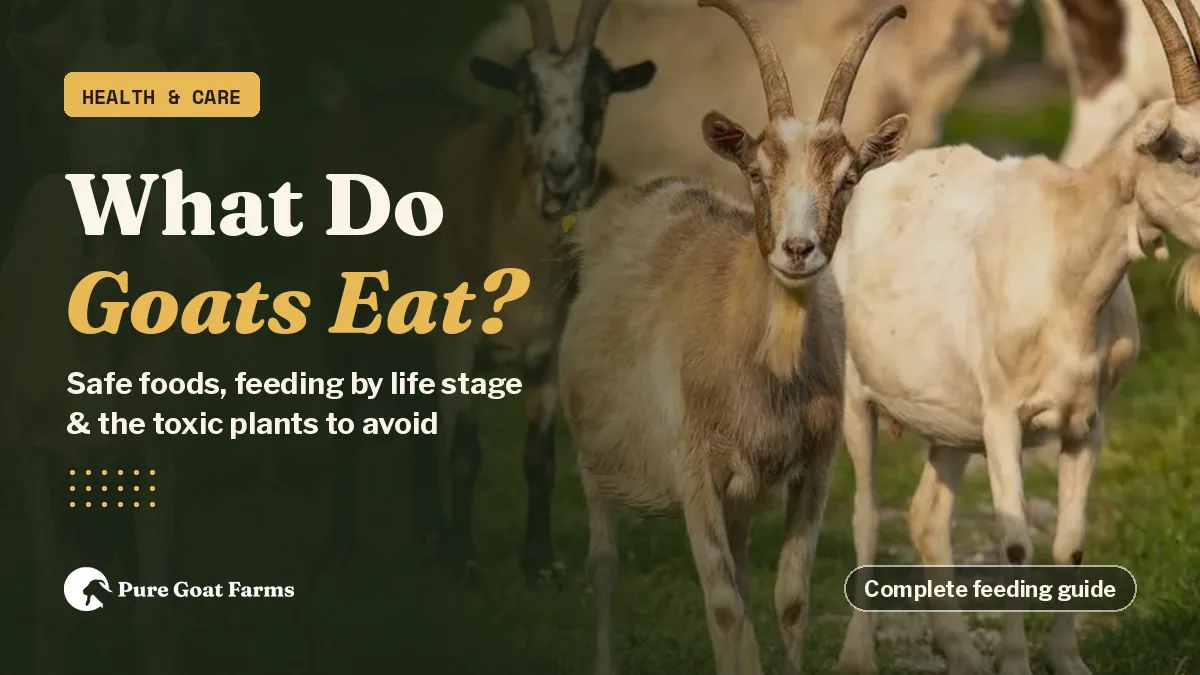
Goats eat mostly hay, pasture and browse: leaves, twigs, brush, weeds and grasses. Forage should make up at least 75–80% of the diet. On top of that, goats need free-choice loose goat minerals, unlimited clean water and, for milking does and growing kids, a measured amount of grain. Fruit and vegetables are fine as treats. Some common plants, including azalea, rhododendron, yew, oleander, mountain laurel and wilted cherry leaves, are poisonous and should never be within reach.
It is one of the first questions every new goat owner asks, and the internet does not help. Cartoons show goats chewing tin cans. Your neighbor swears they will eat anything. The feed store sells six kinds of “goat feed.” The truth is simpler and much more specific. Goats are picky, curious browsers with a sensitive four-chambered stomach, and what you feed them decides how healthy they are, how much milk they give and how long they live.
This guide covers what goats eat in the wild and on a farm, how much hay and grain they really need, what changes for kids, pregnant does, milkers and bucks, which treats are safe, and which plants and foods can kill a goat. If you want numbers for your own herd, our Goat Feed & Hay Calculator will estimate daily hay, grain and water in seconds.
How a Goat’s Digestive System Works
Goats are ruminants, like cattle and sheep. Their stomach has four compartments: the rumen, reticulum, omasum and abomasum. The rumen is the big one. It is a fermentation vat full of bacteria and protozoa that break down fiber a human or dog could never digest. That is why goats can live on leaves and stems. It is also why their diet has to stay fiber-heavy and change slowly.
Two things follow from this:
- Fiber comes first. The rumen microbes need long-stem fiber (hay, browse, pasture) to keep working. A diet that is mostly grain upsets the rumen and leads to acidosis, bloat and enterotoxemia.
- Changes must be gradual. The microbes adapt to whatever the goat eats. Switch hay, add grain or turn goats onto lush pasture too fast and the microbes cannot keep up. Make any feed change over 7 to 14 days.
Goats also chew cud, which means they bring food back up to chew again. A goat lying in the shade, jaw working steadily, is a healthy goat. A goat that stops chewing cud is often the first sign something is wrong.
Goats Are Browsers, Not Grazers
Here is the biggest misconception: goats are not lawnmowers. Sheep and cattle are grazers that prefer short grass. Goats are browsers, closer to deer. Given the choice, they stand on their hind legs to eat leaves, shrubs, vines, tree bark, weeds and brambles, and they eat the top of a plant before the bottom.
This is also good parasite control. Most stomach-worm larvae live in the bottom two to three inches of grass. Goats that browse at head height pick up far fewer worms than goats forced to graze a short, overstocked pasture. If you can give your herd access to brush, wooded edges or a weedy fence line, you are feeding them the way they are built to eat.
Favorite browse plants include blackberry and raspberry canes, multiflora rose, honeysuckle, kudzu, poison ivy (goats are unaffected by it), willow, maple, oak leaves in moderation, mulberry, sumac, clover, dandelion, plantain and chicory.
What Do Goats Eat Every Day? The Core Diet
A balanced goat diet has four parts. Get these right and the treats and supplements matter much less.
1. Hay and Forage (75–100% of the Diet)
Hay is the foundation, especially in winter or when browse is limited. A goat eats about 3 to 4% of its body weight in dry matter every day, and lactating dairy does can eat 4 to 5%. In practice that means:
- A Nigerian Dwarf or Pygmy (60–75 lb): roughly 2 to 3 lb of hay a day.
- A full-size dairy or meat goat (130–180 lb): roughly 4 to 6 lb of hay a day.
Those figures include some waste. Goats pull hay out, step on it and then refuse to eat anything that has touched the ground. A good keyhole or slatted feeder easily pays for itself in saved hay.
There are two main types of hay:
- Grass hay (timothy, orchard grass, brome, Bermuda, meadow mix) is lower in protein and calcium. It is ideal for wethers, bucks and dry does.
- Legume hay (alfalfa, clover, peanut) is high in protein and calcium. It is excellent for milking does, pregnant does in late gestation and growing kids.
Whatever the type, look for hay that is green, leafy, fine-stemmed and smells sweet. Never feed hay that is dusty, moldy, musty or hot inside the bale. Mold can cause listeriosis and respiratory disease.
2. Loose Minerals (Free Choice, Always)
Goats need trace minerals that hay and pasture rarely supply in full, especially copper, selenium and zinc. Low copper shows up as a faded, rough coat, a “fish tail” (bald tail tip), poor fertility and heavier worm loads. Selenium deficiency causes weak kids and white muscle disease.
- Use a loose mineral formulated for goats, not a block. Goats have soft tongues and cannot lick enough from a hard block.
- Do not use sheep minerals. They are deliberately low in copper because copper is toxic to sheep, so goats on sheep mineral end up deficient.
- Put minerals in a covered feeder, keep them dry and offer them free choice so each goat takes what it needs.
Many keepers also put out baking soda free choice in a separate dish. Goats nibble it when their rumen feels off, and it is a cheap safeguard against mild acidosis. It never replaces minerals.
3. Clean Water (More Than You Think)
A goat drinks about 1 to 2 gallons of water a day, and a milking doe in summer can drink 3 to 4 gallons. Goats are fussy drinkers. They refuse dirty water or water with hay floating in it. Scrub buckets often, keep water out of direct sun in summer, and use a heated bucket or de-icer in winter. Goats drink noticeably more when water is lukewarm, which matters for milk production and for preventing urinary stones in bucks and wethers.
4. Grain or Concentrate (Only When Needed)
Grain is not a daily requirement for every goat. It is a tool for goats with high energy needs: does in milk, does in the last month of pregnancy, growing kids and very thin animals. Pet wethers and most bucks outside breeding season do fine on good hay, browse and minerals alone, and too much grain makes them fat and prone to urinary calculi.
When you do feed grain:
- Choose a goat-specific pelleted or textured feed with 14–18% protein. Many goat feeds contain ammonium chloride to help prevent urinary stones.
- A common rule for dairy does is about 1 lb of grain for every 3 lb of milk she gives, split between milkings.
- Never let goats get into the feed bin. Gorging on grain is one of the most common causes of fatal bloat and enterotoxemia. Keep goats vaccinated with CD&T as a safety net.
| Feed | Who needs it | Typical daily amount (full-size goat) |
|---|---|---|
| Grass hay / pasture / browse | Every goat | 3–4% of body weight (about 4–6 lb) |
| Alfalfa hay or pellets | Milkers, late-pregnant does, kids | Part of the forage ration, 1–3 lb |
| Goat grain (14–18% protein) | Milkers, late-pregnant does, growing kids | 0–3 lb, based on production |
| Loose goat minerals | Every goat | Free choice (about ¼–½ oz) |
| Baking soda | Optional, every goat | Free choice |
| Water | Every goat | 1–4 gallons |
What Goats Eat at Each Life Stage
The core diet stays the same throughout a goat’s life, but the balance shifts.
Newborn and Young Kids
Kids need colostrum within the first few hours of birth, about 10% of their body weight in the first 24 hours. Colostrum carries the antibodies that protect them until their own immune system works. After that, kids live on milk from the doe or a bottle. If you are bottle-raising, use real goat milk or a kid-specific milk replacer, never a calf replacer.
Kids start nibbling hay and grain within one to two weeks. Offer soft, leafy hay and a little creep feed early so the rumen develops, and wean gradually at 8 to 12 weeks, once they are eating solid feed well.
Pregnant Does
For the first three months of a five-month pregnancy, a doe needs little more than good hay and minerals. Overfeeding early on makes does fat, and fat does are at higher risk of pregnancy toxemia and hard kiddings. In the last four to six weeks, when the kids grow fastest, slowly add alfalfa and a small amount of grain to build energy. Our Goat Gestation & Kidding Date Calculator tells you exactly when that window starts.
Milking Does
A doe at peak lactation has the highest nutritional needs of any goat on the farm. She needs top-quality hay with alfalfa, grain matched to her milk yield, minerals, and plenty of water. If her production is lower than you expect, our guide on how to increase goat milk production walks through the feed fixes in order. Breed matters too. Compare expected yields in best dairy goat breeds for milk.
Bucks and Wethers
Male goats, especially castrated wethers, are prone to urinary calculi (bladder stones), which can block the urethra and kill a goat within a day or two. Prevention is mostly dietary:
- Feed mainly grass hay and keep alfalfa limited.
- Keep grain to a minimum or none at all. Grain is high in phosphorus, and the target calcium-to-phosphorus ratio is about 2:1.
- Encourage drinking with clean, lukewarm water and loose minerals that contain salt.
- Watch for straining, dribbling urine or a hunched stance, and call a vet immediately if you see them.
What Can Goats Eat as Treats?
Treats are the fun part, and they are great for taming shy goats, training and getting a doe onto the milking stand. Keep them to no more than about 10% of the daily diet, cut produce into small pieces to prevent choking, and introduce new foods slowly.
| Safe treats goats love | Feed sparingly |
|---|---|
| Apples (cored, sliced) | Bread, crackers and cereal (high starch) |
| Carrots and carrot tops | Raisins and dried fruit (high sugar) |
| Bananas and banana peels | Corn (high starch) |
| Pumpkin, squash and their seeds | Grapes |
| Watermelon and cantaloupe rinds | Spinach and kale (oxalates in large amounts) |
| Lettuce, celery, cucumber | Cabbage and broccoli (can cause gas) |
| Pears, peaches (pits removed), berries | Commercial goat treats |
| Black oil sunflower seeds (BOSS) | Peanuts (unsalted) |
| Pine and Christmas trees (unsprayed) | Citrus peels |
A small handful of black oil sunflower seeds is a popular coat conditioner in winter, and an unsprayed Christmas tree after the holidays is a goat favorite. Pine needles are a natural source of vitamin C. (Pregnant does should not get large amounts of pine.)
What Goats Should Never Eat: Toxic Plants and Foods
Goats are curious, but they are not immune to poison. Hungry, bored or newly moved goats are the most likely to eat something dangerous, so walk every new pasture and fence line before turning goats out.
Poisonous Plants
- Azalea and rhododendron. Among the most common causes of goat poisoning. A few leaves can cause vomiting, drooling, bloat and death.
- Mountain laurel, Japanese pieris and other heath-family shrubs. Same toxin (grayanotoxin) as azalea.
- Yew (Japanese and English). Extremely toxic. Often fatal within hours, with little warning.
- Oleander. Affects the heart, even in small amounts.
- Wild cherry, chokecherry and plum leaves when wilted. Wilting releases cyanide. Fresh leaves are less dangerous, but storm-damaged branches are a classic killer.
- Nightshade, jimsonweed and green potato or tomato plants.
- Poison hemlock and water hemlock. Water hemlock is one of the most toxic plants in North America.
- Milkweed, foxglove, lily of the valley and lantana.
- Bracken fern (over time) and rhubarb leaves.
Plants vary by region, so check with your county extension office for a local list.
Foods to Keep Away From Goats
- Avocado (leaves, skin and pit contain persin, which damages the heart).
- Chocolate, coffee and caffeine.
- Meat, dairy leftovers, dog food and cat food. Goats are herbivores.
- Moldy or spoiled food of any kind, including moldy hay and bread.
- Lawn clippings. They ferment quickly in a pile and can cause bloat, and they may carry chemicals.
- Onions, garlic and leeks in quantity.
- Salty, sugary or processed snacks.
Signs of poisoning include drooling or foaming, vomiting (rare in ruminants and always serious), bloat, staggering, crying out in pain, rapid breathing and seizures. Call your vet immediately and try to identify what the goat ate.
Common Goat Feeding Mistakes
Most feeding problems we hear about come from the same few habits:
- Feeding too much grain. Grain-fat goats have more kidding trouble, more urinary stones and more bloat. Hay first.
- Changing feed suddenly. A new bag of grain, a new hay cutting or a lush spring pasture all need a slow transition.
- Using sheep or all-stock minerals. These often leave goats short of copper.
- Feeding hay on the ground. It gets wasted and spreads parasites.
- Ignoring body condition. Feel along the spine and ribs every few weeks. You should feel ribs with light pressure but not see them sharply.
- Overdoing treats. A goat that fills up on apples and crackers eats less of the forage it actually needs.
A Simple Daily Feeding Routine
Here is a routine that works for a small mixed herd:
- Morning: Check and refill water. Fill hay feeders. Milking does get their grain ration on the stand.
- Midday: Turn out to pasture or browse if available. Top up minerals and baking soda.
- Evening: Refill hay, check water again, feed the evening grain ration to milkers and watch everyone eat. A goat that hangs back from the feeder is worth a closer look.
If you buy hay by the bale, run your herd through our feed calculator before winter so you know how many bales you need to get through to spring.
Final Thoughts
So, what do goats eat? Mostly what nature built them for: plenty of hay, browse and pasture, backed up by loose goat minerals and clean water, with grain used deliberately for the goats that need it. Keep treats small, change feeds slowly, and learn to recognize the toxic plants on your property. Do those things and your goats will reward you with shiny coats, easy kiddings and a full milk pail.
FAQs
What do goats eat the most?
Forage. Hay, pasture and browse (leaves, shrubs, weeds and brush) should make up at least 75 to 80 percent of a goat's diet. A full-size goat eats roughly 3 to 4 percent of its body weight in dry matter each day, which is about 4 to 6 pounds of hay.
What can goats eat as treats?
Safe treats include apples, carrots, bananas and banana peels, pumpkin, squash, watermelon rind, lettuce, celery, berries, pears, black oil sunflower seeds and unsprayed pine or Christmas trees. Keep treats to about 10 percent of the diet and cut produce into small pieces.
What is poisonous to goats?
Common toxic plants include azalea, rhododendron, mountain laurel, Japanese pieris, yew, oleander, wilted wild cherry or plum leaves, nightshade, poison and water hemlock, milkweed, foxglove and lantana. Avocado, chocolate, moldy feed, meat, pet food and lawn clippings should also be kept away from goats.
Do goats need grain every day?
No. Grain is mainly for milking does, does in late pregnancy, growing kids and underweight goats. Pet wethers and most bucks do well on good hay, browse, loose minerals and water, and too much grain raises the risk of bloat and urinary stones.
Can goats eat grass?
Yes, goats eat grass, but they prefer browse such as leaves, brush and weeds. Eating at head height rather than grazing short grass also lowers their exposure to stomach worms.
How much water does a goat drink per day?
Most goats drink 1 to 2 gallons of water a day. A milking doe in hot weather can drink 3 to 4 gallons. Keep water clean, cool in summer and unfrozen in winter.

We're a family-run dairy-goat farm with 27 goats across six breeds. Every guide is tested on our own herd before it's published. More about us.