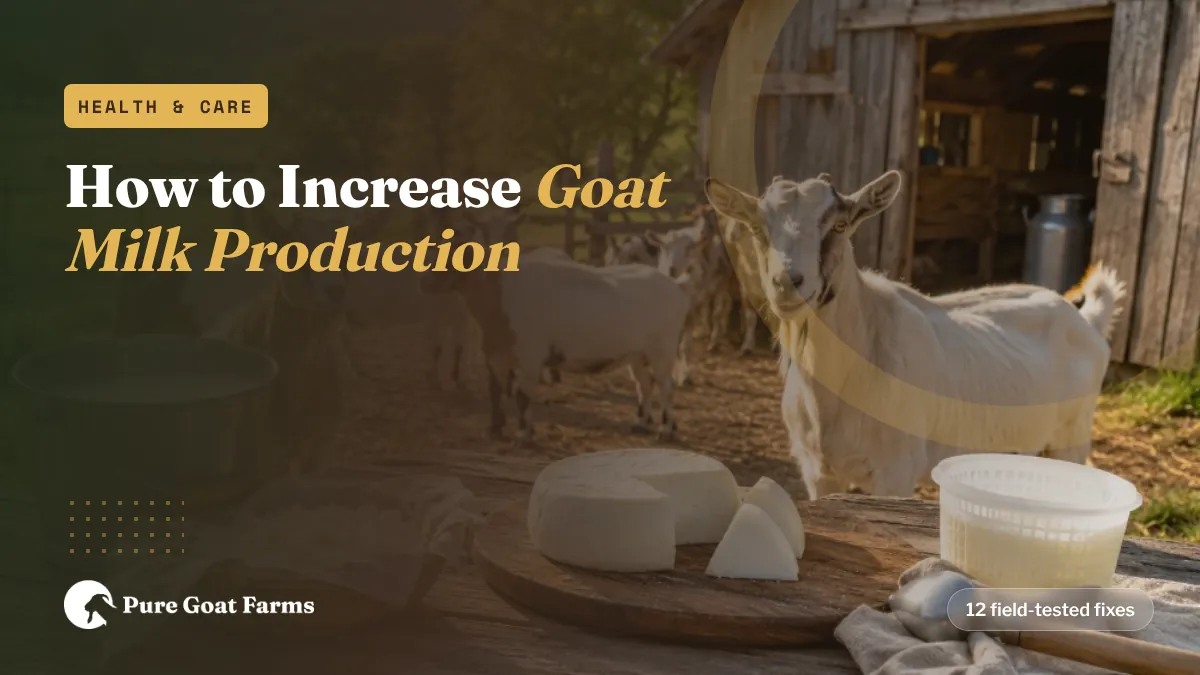
How to Increase Goat Milk Production: 12 Field-Tested Fixes
Quick answer
To increase goat milk production, start with the basics in this order: unlimited clean water, high-quality forage (especially alfalfa), a balanced dairy ration fed on the stand, free-choice loose minerals, and a consistent twice-a-day milking schedule. Then rule out the hidden milk thieves — parasites, mastitis and stress. Most does respond within one to three weeks.
Few things are as discouraging as a doe who milked beautifully last season and now barely covers the bottom of the pail. Before you blame her genetics, it is worth knowing that most drops in goat milk production come from management — and management can be fixed.
These are the twelve changes that have made the biggest difference on our own milking stand at Pure Goat Farms, roughly in the order we check them.
First, Know What “Normal” Looks Like
You cannot increase milk production if you do not know what your doe is producing. Weigh every milking for a week and compare her to realistic numbers for her breed, age and stage of lactation. Our breed chart in how much milk does a goat produce per day is a good benchmark, and the Goat Milk Production Estimator will show where she should be on her lactation curve.
Remember that some decline is natural. After peaking around six to eight weeks post-kidding, production slowly drops each month. A doe at month seven giving less than at month two is normal; a doe giving half of what she gave last week is not.
1. Give Unlimited Clean, Fresh Water
Goat milk is about 87% water. A lactating doe can drink 2 to 4 gallons a day or more in hot weather. If water is dirty, warm in summer, frozen in winter or hard to reach because of a bossy herd mate, milk drops fast.
- Scrub buckets daily; goats refuse contaminated water.
- Offer lukewarm water in winter — does drink noticeably more.
- Provide more than one water station if you have a dominant doe.
2. Upgrade Your Hay
Forage is the foundation of milk. Coarse, stemmy or dusty hay simply does not have the protein and energy a milking doe needs. Look for leafy, green, fine-stemmed hay, and feed generously — dairy goats should always have forage in front of them.
3. Add Alfalfa
If your does are on grass hay alone, adding alfalfa is often the single biggest milk boost. Alfalfa is high in protein and calcium, both critical for milk production. Feed alfalfa hay or pellets as part of the forage ration.
4. Feed a Proper Dairy Ration on the Stand
Lactating does need more energy than forage alone can supply. A common rule of thumb is about 1 pound of dairy goat ration per 3 pounds of milk she produces, fed split between milkings. Increase gradually — no more than about a quarter pound per day — to avoid digestive upset.
Use our Goat Feed & Hay Calculator to estimate daily hay, grain and water for your herd.
5. Provide Free-Choice Loose Minerals
Copper, selenium, zinc and other trace minerals affect fertility, immunity and milk yield. Use a loose mineral formulated for goats (not a sheep mineral, which is low in copper) and keep it available at all times. Mineral blocks are too hard for goats to get enough from.
6. Milk on a Consistent Schedule
Goats thrive on routine. Milk at the same times every day, ideally 12 hours apart, and do not shift times on weekends. Inconsistent intervals tell the doe’s body to make less. Our guide to how often to milk a goat covers schedules in detail.
7. Milk Out Completely
Milk left in the udder signals the body to reduce production. Finish each milking by gently bumping the udder (as a kid would) and stripping out the last milk. A hand milker or good technique helps if your hands tire.
8. Consider Three Milkings a Day at Peak
For high-producing does in early lactation, adding a third milking can increase total daily yield. It is extra work, so most home keepers save it for a doe they are trying to build up after kidding.
9. Control Internal Parasites
Barber pole worm and other parasites quietly steal blood and nutrients that would otherwise go into milk. Check FAMACHA eye color regularly, run fecal egg counts, and work with your vet on a targeted deworming plan rather than routine blanket dosing.
10. Check for Mastitis
Subclinical mastitis — infection without obvious symptoms — can cut milk from one half without you noticing. Run a California Mastitis Test monthly and whenever production drops, use a post-milking teat dip, and keep bedding clean and dry.
11. Reduce Stress and Heat
Stress hormones block milk let-down. Common stressors include new herd mates, dogs, rough handling, loud noise and changes in routine. Heat stress is just as damaging: provide shade, airflow and cool water in summer, and milk during the cooler parts of the day.
12. Manage Kids and the Lactation Plan
Kids nursing full time can take half or more of the doe’s milk. Separating them overnight and milking in the morning lets you share. Longer term, breeding decisions matter: does from milk-recorded lines, kidded at a good body condition and given a proper dry period, produce more next season. Plan dry-off with the goat gestation calculator.
Milk Production Problem Checker
| What you see | Likely cause | First thing to try |
|---|---|---|
| Sudden drop in both halves | Stress, heat, water problem, feed change, heat cycle | Check water and routine; take her temperature |
| One half producing less | Mastitis or injury | Run a CMT; check for heat or lumps |
| Gradual decline, pale eyelids | Parasites | FAMACHA score and fecal egg count |
| Low milk, thin doe | Not enough energy or protein | Improve hay, add alfalfa, adjust ration |
| Low milk, rough coat, poor fertility | Mineral deficiency | Free-choice goat loose mineral |
| Steady slow decline after month 3 | Normal lactation curve | Nothing — this is expected |
What Does Not Work
- Dumping in more grain overnight. Sudden grain increases cause bloat and acidosis, which reduce milk.
- Miracle supplements. Herbs like fenugreek are popular, but evidence in goats is thin. Fix water, forage and minerals first.
- Expecting a Nigerian to milk like a Saanen. Genetics set the ceiling. Compare breeds in our best dairy goat breeds guide.
Final Thoughts
Increasing goat milk production is rarely about one secret trick. It is about removing the bottlenecks one by one: water, forage, protein, minerals, routine and health. Fix those, and most does will reward you within a couple of weeks.
Keep weighing the milk as you make changes. The scale tells you what worked — and that record is the best tool any goat keeper can have.
FAQs
What is the fastest way to increase goat milk production?
The fastest gains usually come from fixing water and forage first: unlimited clean, lukewarm water and better-quality hay (alfalfa or a leafy grass-alfalfa mix). Many does respond within 5 to 10 days. Adding a properly balanced dairy ration on the stand and keeping a steady twice-a-day milking schedule usually adds more over the following weeks.
Does alfalfa increase goat milk?
Alfalfa is one of the most useful feeds for dairy goats because it is high in protein and calcium, both of which milk production depends on. Feeding part of the forage ration as alfalfa hay or pellets commonly lifts yield in does that were on grass hay alone.
Why did my goat's milk production suddenly drop?
A sudden drop usually points to stress, a change in feed, heat, an empty water bucket, mastitis, a parasite load, or the doe coming into heat. Check her temperature, run a CMT on each half of the udder, check FAMACHA eye color and look at what changed in the last two or three days.
Does milking three times a day increase goat milk?
For high-producing does in early lactation, three milkings a day can raise total daily yield because the udder is emptied more often. For most home herds the extra labor is not worth it; consistent twice-a-day milking 12 hours apart captures most of the benefit.
Can herbs or supplements increase goat milk supply?
Some keepers use galactagogue herbs such as fenugreek or fennel, but evidence in goats is limited. Correcting a protein, energy, water or mineral shortfall will almost always do far more than any single supplement.

We're a family-run dairy-goat farm with 27 goats across six breeds. Every guide is tested on our own herd before it's published. More about us.